We develop AI technologies that innovate manufacturing processes, from novel material discovery through process design and control. Our ultimate goal is to realize AI-native manufacturing processes, in which AI agents autonomously learn, adapt, and reconfigure processes beyond the limits of human intuition. To this end, we pursue research across the four core areas of process systems engineering: process modeling, process design, process control, and process monitoring.
Process Modeling & Simulation
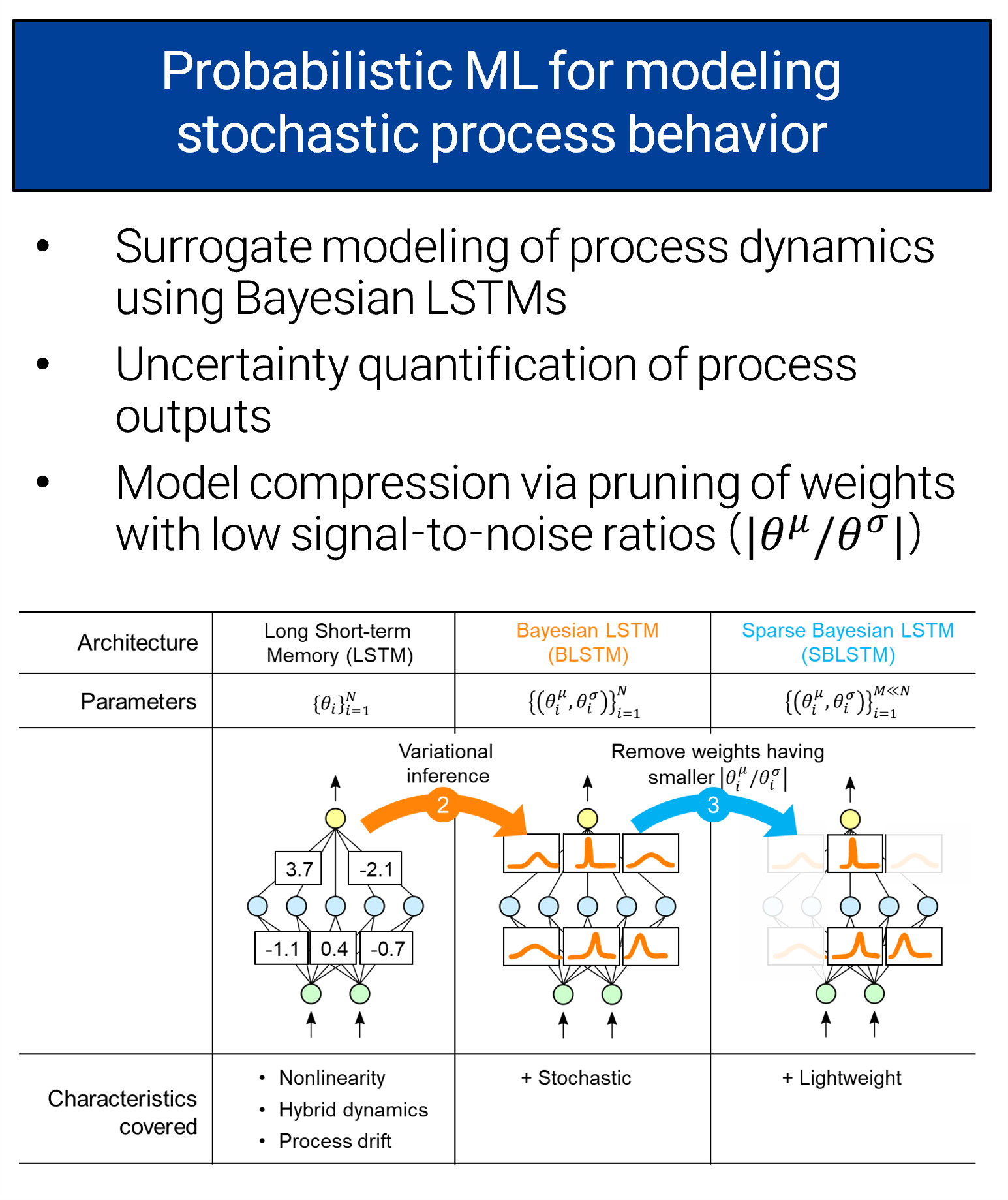
We develop process models that form the foundation of process design and control. We combine first-principles modeling based on governing equations from reaction engineering and thermodynamics with data-driven modeling using universal approximators such as artificial neural networks, to accurately describe steady-state and dynamic behavior. When physical properties required for process design are missing, we predict them with AI models based on molecular structure, such as graph neural networks. When there is not enough data to train AI models, we also predict properties using computational chemistry methods such as DFT/AIMD.
Related Publications
View all →- ▸Computational screening of sodium solid electrolytes through unsupervised learning2024 · npj Computational Materials
- ▸Sparse Bayesian long short-term memory networks for computationally efficient stochastic modeling of plasma etch processes2022 · Computers & Chemical Engineering
Related Projects
View all →- ▸Computational Screening of Sodium-based Solid-state Electrolytes Through Unsupervised Clustering2024.05 - 2025.04
- ▸Development of Low-cost CO2 Capture Technology Tailored to Emission Sources for Technology Export2025.04 - 2026.02
- ▸Development of CO₂ Conversion Processes for Alkyl Formate Production and High-Value Chemical Material Upgrading2026.04 - 2030.12
- ▸Education and Research Group for Convergent Chemical Materials in the 4th Industrial Revolution Era2026.03 - 2027.08
- ▸Initiative for AI- and Robot-based Autonomous Chemical Process Design2026.06 - 2027.01
- ▸SYN-BRIDGE 1.0: SYNthetic Biology Regional Integration for Development, Growth, and Education2026.09 - 2029.12
Process Design & Optimization
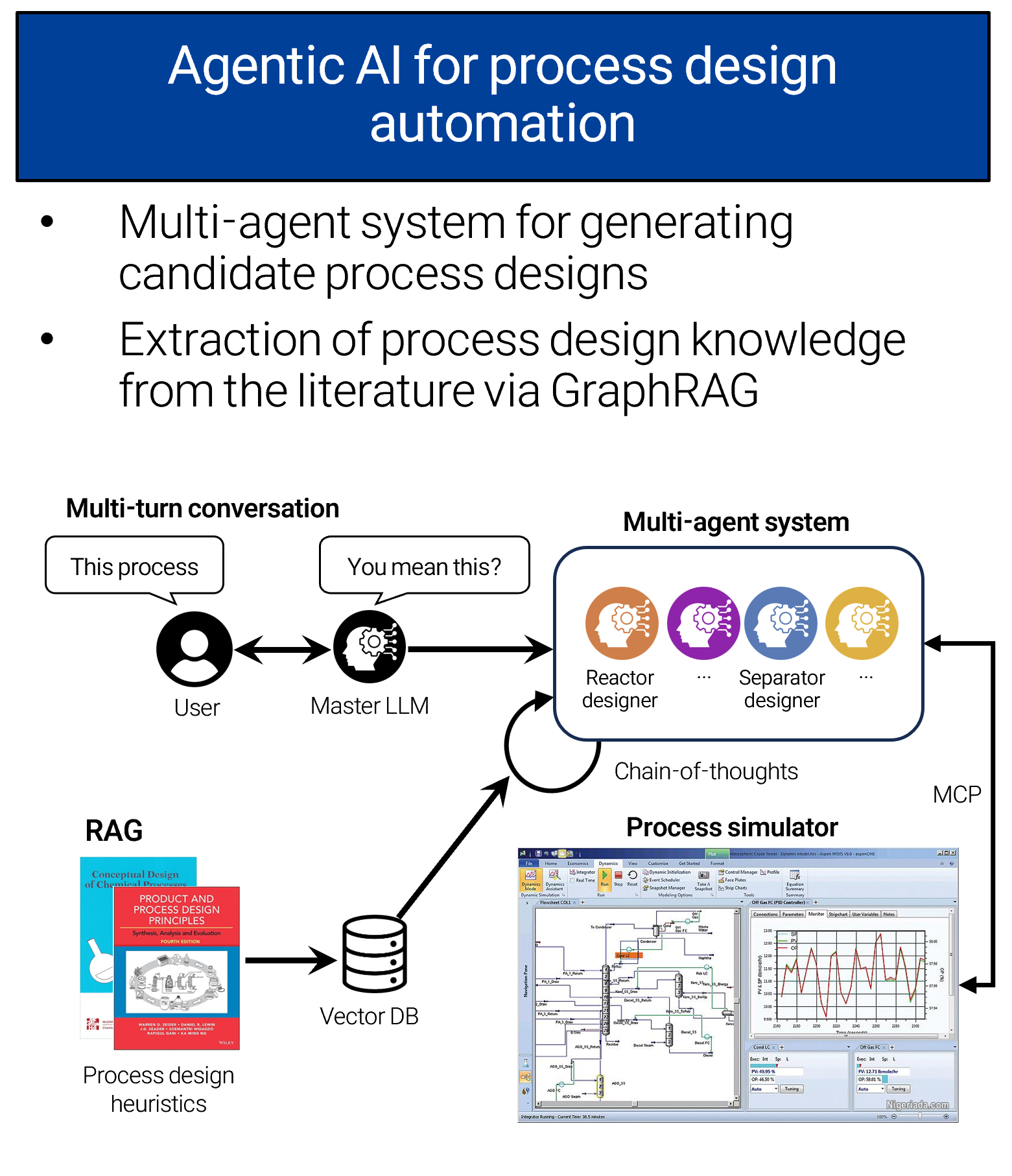
Based on steady-state models, we design processes that produce target products from raw materials and conduct multi-objective optimization research that simultaneously maximizes economic and environmental performance. By applying various optimization algorithms such as Bayesian optimization and superstructure optimization, we design many types of chemical processes, including CO2 conversion (CCU) and bioprocesses. We also study agentic AI–based autonomous process design, developing methods in which AI performs process modeling and optimization on its own.
Related Publications
View all →- ▸Accelerating the net-zero economy with CO2-hydrogenated formic acid production: Process development and pilot plant demonstration2024 · Joule
- ▸Techno-economic analysis of micro-grid system design through climate region clustering2022 · Energy Conversion and Management
- ▸Design study of a cryogenic distillation column for hydrogen isotope separation system2021 · Fusion Engineering and Design
Related Projects
View all →- ▸Development of a Formic Acid Production Process via Simultaneous Carbon Dioxide Capture and Hydrogenation2024.01 - 2025.04
- ▸Development of Simultaneous CO2 Capture and Conversion Technology for Low-Temperature Methanol Synthesis Using Active Learning2022.11 - 2026.02
- ▸Development of Low-cost CO2 Capture Technology Tailored to Emission Sources for Technology Export2025.04 - 2026.02
- ▸Development of CO₂ Conversion Processes for Alkyl Formate Production and High-Value Chemical Material Upgrading2026.04 - 2030.12
Process Control & Operation
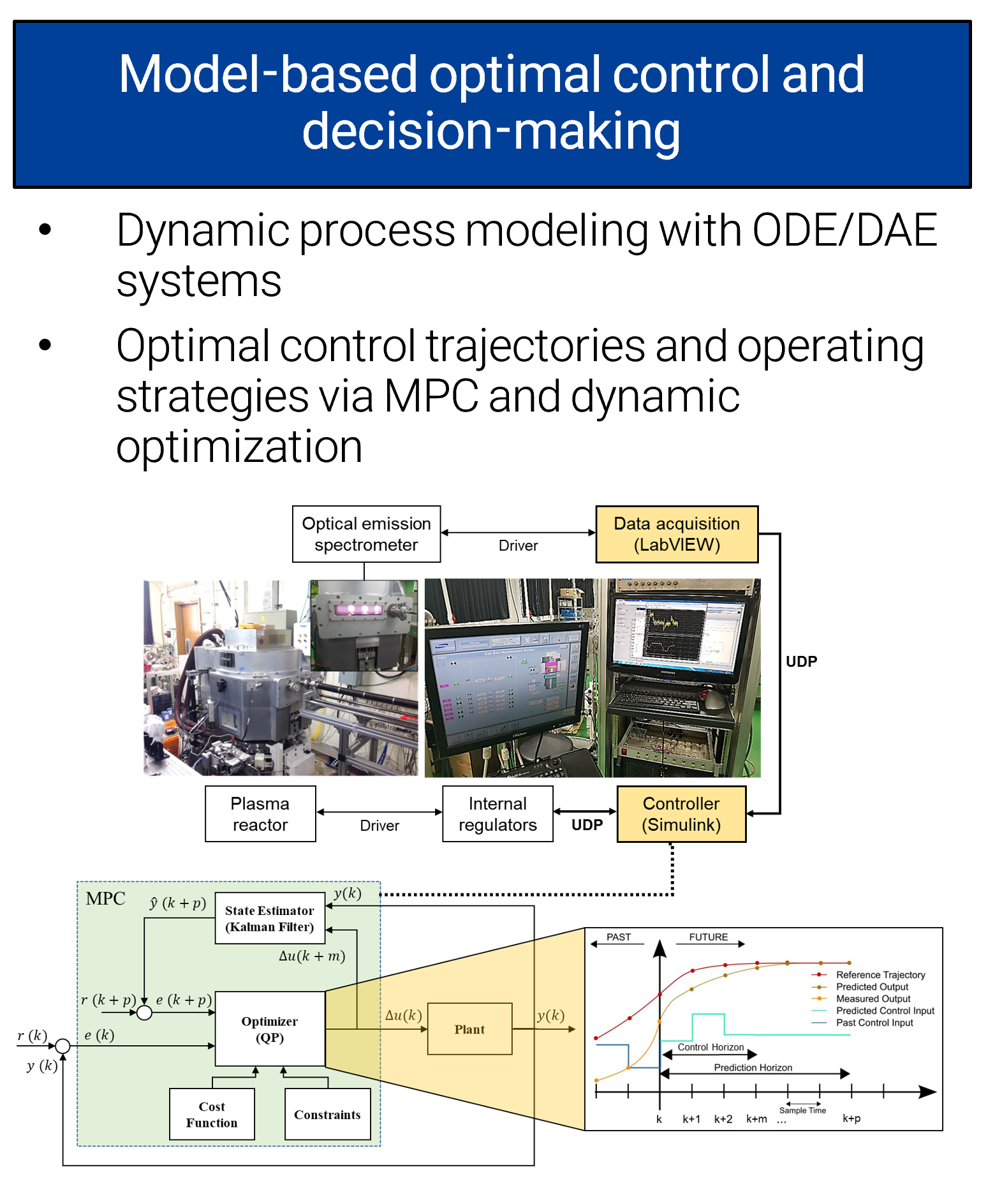
We develop optimal operating strategies for chemical processes based on dynamic models and data. We apply optimization-based control techniques such as model predictive control (MPC), dynamic optimization, and reinforcement learning to chemical, semiconductor, and bioprocesses. We build control loops using tools such as Python and Simulink Desktop Real-Time, and improve the economics and stability of processes through real-time control. We also use design of experiments (DoE) techniques to efficiently explore the uncertainties that arise in process operation.
Related Publications
View all →- ▸Perfusion‐Based Production of rAAV via an Intensified Transient Transfection Process2025 · Biotechnology and Bioengineering
- ▸Dynamic optimization of cryogenic distillation operation for hydrogen isotope separation in fusion power plant2021 · International Journal of Hydrogen Energy
- ▸Bayesian Optimization of Semicontinuous Carbonation Process Operation Recipe2021 · Industrial & Engineering Chemistry Research
Related Projects
View all →- ▸Development of Equipment Control Algorithm Based on Plasma Monitoring for Efficiency Improvement of 10 nm Etch Process2015.03 - 2019.05
- ▸Development of ITER Fuel Cycle Technology2019.01 - 2020.12
- ▸Continuous Viral Vector Manufacturing Based on Mechanistic Modeling and Novel Process Analytics2021.10 - 2022.07
- ▸Development of Low-cost CO2 Capture Technology Tailored to Emission Sources for Technology Export2025.04 - 2026.02
- ▸Development of CO₂ Conversion Processes for Alkyl Formate Production and High-Value Chemical Material Upgrading2026.04 - 2030.12
- ▸SYN-BRIDGE 1.0: SYNthetic Biology Regional Integration for Development, Growth, and Education2026.09 - 2029.12
Process Monitoring & Safety
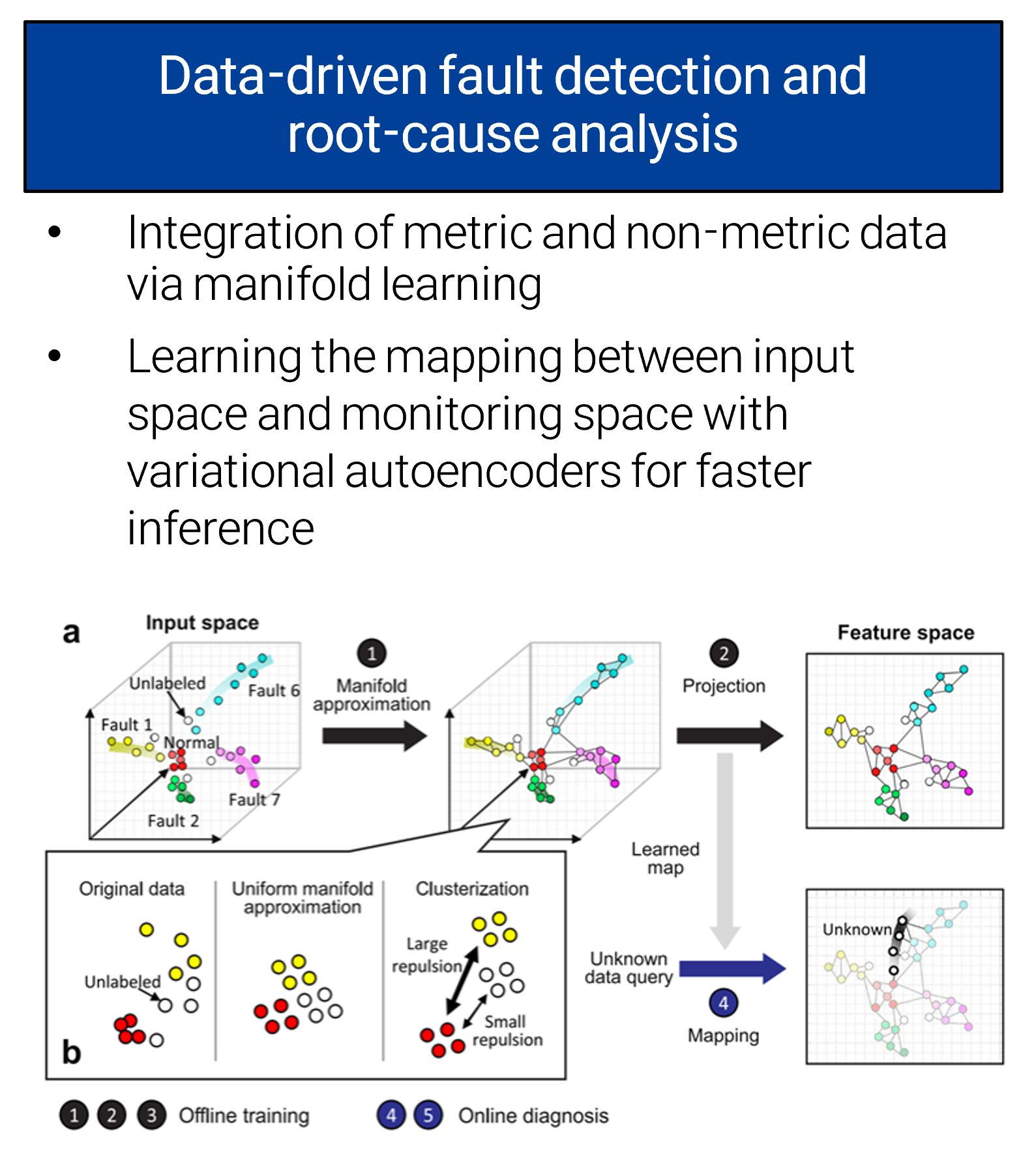
We study early detection and prevention of process faults and accidents from both big data and sparse data. By combining multivariate statistical techniques with machine learning (e.g., data manifold learning and Bayesian neural networks), we perform anomaly detection and root-cause diagnosis, and implement soft sensing for unmeasurable variables. We also model sparse safety-related data with probability distribution functions to support conservative decision-making and predictive maintenance scheduling, and conduct knowledge graph–based Graph RAG research for the automatic generation of standard operating procedures (SOPs).
Related Publications
View all →- ▸Dynamic Maintenance of Underground Pipelines via a Systematic Approach for Conservative Estimation of Pipeline Defect Probability Density Under Data Scarcity2024 · Korean Journal of Chemical Engineering
- ▸Clustered Manifold Approximation and Projection for Semisupervised Fault Diagnosis and Process Monitoring2021 · Industrial & Engineering Chemistry Research
- ▸Improvement of principal component analysis modeling for plasma etch processes through discrete wavelet transform and automatic variable selection2016 · Computers & Chemical Engineering